Over £1,000 for Archer Project

The audience at Sheffield Bach Choir’s annual Messiah donated a magnificent £1, 157.86 for the cathedral’s Archer Project, which supports homeless people across Sheffield.

‘We are really grateful to all those who contributed.’ said choir Chair Chris Walker. ‘ A fantastic amount for a wonderful charity, and much needed especially at this time of year’.

The choir always holds a collection for the Archer collection at their annual Messiah performance, following a tradition started by Handel himself, who gave a performance of Messiah in 1750 in aid of one of his favourite charities, the Foundling Hospital, founded in 1739 by Thomas Coram, a philanthropic sea captain.

‘The Archer Project has supported thousands of people for over thirty years, aiming to help them into accommodation and to build fulfilling lives.’ explained Chris. ‘It started back in the 1980’s when the cathedral’s congregation providing homeless individuals with shelter and a basic breakfast. It has since developed into a service designed to help homeless people to improve their lives. Sheffield Bach Choir is very pleased to help support it’.

The concert itself was very well received by an enthusiastic audience, which leapt to its feet when the final ‘Amen’ had finished echoing round the cathedral. A wonderful evening rounded off with a most magnificent collection for this worthy charity.

You can read more about the Archer Project at https://www.archerproject.org.uk/

Standing ovation for Messiah

Sheffield Bach Choir, along with friends from St Peter’s Singers and Sheffield Philharmonic Chorus, sang Handel’s Messiah on Monday evening, and the audience leapt to their feet in appreciation at the magnificent conclusion.

‘What a terrific performance! … With the orchestra in fine form and a great team of soloists keeping us on our toes it’s no wonder the adrenaline flew in abundance.’ said conductor George Nicholson. The choir ‘clearly picked up the charge that was in the air and the results were amazing. …..a brilliant performance!’

Sally Robinson’s National Festival Orchestra were on great form, giving a polished and committed performance, not least the amazing Anthony Thompson, who played the trumpet accompaniment to ‘the Trumpet shall sound’, marvellously sung by bass-baritone Florian Stӧrtz. Tenor David Brown started the evening with a lyrical ‘Comfort Ye’, and beautiful singing from both alto Hannah Mason and soprano Nicola Hooke soared around the cathedral as though from angels themselves.

‘It was amazing and although I’m no expert ,the music and the atmosphere was definitely the best and I have listened to 35 of your Messiahs.’ said one audience member. ‘It was most enjoyable and such a quality performance by ALL. Thank you.’ echoed another.

Mesmerising Messiah

Monday 2 December 2019

Sheffield Bach Choir’s annual performance of Messiah alongside the National Festival Orchestra, conducted by Dr. Simon Lindley, offered Sheffield music lovers a splendid opportunity to include a live performance of Handel’s wonderful oratorio in their Christmas preparations. The choir quite obviously enjoy singing this wonderful oratorio, which they clearly know very well indeed, and soloists Peyee Chan, Margaret McDonald, Tim Kennedy and James Geidt were quite magnificent, making this was a truly memorable performance.

Beautiful Brahms

BRAHMS FESTIVAL CONCERT
Saturday 5 October 2019, 7.30pm, Sheffield Cathedral

On Saturday 5 October the Bach Choir presented a programme devoted to Brahms, featuring his magnificent German Requiem, the Academic Festival Overture and two beautiful motets. Rising Sheffield star Ella Taylor sang the soprano solos with precision and accuracy – and immense power, filling the cathedral with a superb soprano sound. Acclaimed bass Alex Ashworth sang with drama and immense feeling, and the choir’s huge enjoyment accompanying the two soloists was clearly heard in their rendering of the choruses. Sally Robinson’s National Festival Orchestra played with verve and style, ably conducted by Dr Simon Lindley.  The concert was generously supported by soprano Jane Ginsborg.

Messiah raises record amount for charity

18 December 2018

The choir enjoyed an exceptionally successful performance of Messiah in Sheffield Cathedral on Monday 3 December 2018, with audience reporting it to be our ‘best ever’! Everyone appreciated the National Festival Orchestra’s confident rendition, and the power and accuracy of local soprano Ella Taylor. Counter tenor David Allsopp sang with wonderful sensitivity, and tenor David Brown and bass Quentin Brown gave excellent support.

This annual performance always features a retiring collection for the cathedral’s excellent Archer Project, which this year raised an amazing £1324.55, way higher than last year and quite probably the choir’s highest collection ever for this worthy cause. The choir is grateful to the audience members for their generous contributions.

The choir also sing carols at Waitrose, which raised £131 for choir funds as well as being a cheerful and fun event for all concerned. Thanks are due to everyone who turned out to sing, but a special thank you to David Sanderson for keeping us all in good order!

Here’s wishing all our supporters a very merry Christmas!

Messiah – reflections by Simon Lindley

1 December 2018, Dr Simon Lindley

So pretty nigh universal has its use become, it is scarcely credible to think that the first vocal score of Watkins Shaw’s edition of Messiah only appeared as recently as sixty years ago. It has, generally [though by no means completely] replaced the previous most popular edition, that of Ebenezer Prout printed in 1902 by the same music publisher, Novello & Company Limited, that brought to birth Watkins Shaw’s complete editionissued over a number of years and including full score, a companion compendium, miniature score and orchestral parts as well as a vocal score, the most recent re-incarnation of which appeared as recently as 1992. Not that Shaw’s was the first ‘hat in the ring’ in terms of striving faithfully to reproduce Handel’s intentions without things such as the ‘additional accompaniments’ so beloved by Mozart as well as his later successors.

Shaw’s precursors included John Tobin, Conductor of the London Handel Society who issued an edition for Barenreiter’s complete gamut of Handel’s works as well as earlier figures such as Westminster Abbey organist Sir Frederick Bridge and the vastly under-rated Oxford-based musicologist T W Bourne [1862-1948]. Bourne it was who, in many ways, paved the way for a greater degree of historical ‘authenticity’ and accuracy, decades prior to Dr Shaw’s intervention. Shaw insisted on the proper use of a continuo player to fill out the potential of the composer’s harmonies, written with the assistance of a kind of musical ‘shorthand’ in the form of a system known as ‘figured bass’ in which the intervals that were printed with a number above the cello and bass line advised the player clearly of the composer’s harmonic requirements on important chords as much as less prominent points.

Significant recordings include a trail-blazing EMI LP under Sir Charles Mackerras with the youthful Dame Janet Baker among the soloists being joined by fledgling Nottingham-born counter-tenor Paul Esswood as well as numerous pioneering performances here in the Cathedral by Sheffield Bach Choir under the informed and inspirational direction of the late and great Dr Roger Bullivant MBE, Conductor of the Bach Choir from 1960 until retirement around forty years later.

Though by far the best known of its composer’s many religious works, Messiah is actually the least typical of Handel’s many oratorios. This is due in the main to the special genius of his ‘librettist’ Charles Jennens, who was responsible for the imaginative compilation of the verbal text – a compilation which has, in itself, probably done almost as much to establish the work in the hearts and minds of successive generations as Handel’s music.

Messiah, truly, stands in a class of its own – in some ways as much almost a liturgical observance as a concert piece; not in the manner of the Passion oratorios from the Lutheran tradition, but more as a series of scenarios and reflective tableaux.

Handel was engaged extensively in the composition and presentation of oratorio in London for the last two decades of his life. His business sense and entrepreneurial energy seem to have captured the mood of the age. Had he remained stubbornly committed to opera composition, his twilight years would have been much less comfortable and his public far less appreciative. The keeping of precise financial records, receipt books and “word books” as the programmes of the day were known, during the course of the composer’s performances arranged for the benefit of the Foundling Hospital are of huge benefit to scholars in enabling us to ascertain which selections of the solo material were heard on which occasions.

It is extremely unlikely that the composer ever heard or performed the work wholly complete, though the Bach Choir and many other ensembles are known for presenting the work “cover to cover” to quote a West Riding descriptive of an uncut version of the composer’s magnificent score.

The Bach Choir is proud of, and profoundly grateful for, the considerable support provided each December to a now traditional retiring collection at the close of the evening in aid of the Cathedral’s acclaimed Archer Project for those undergoing difficult times in their lives.

Messiah will be performed in Sheffield Cathedral on Monday 3 December 2018. Go to the current season page for further details.

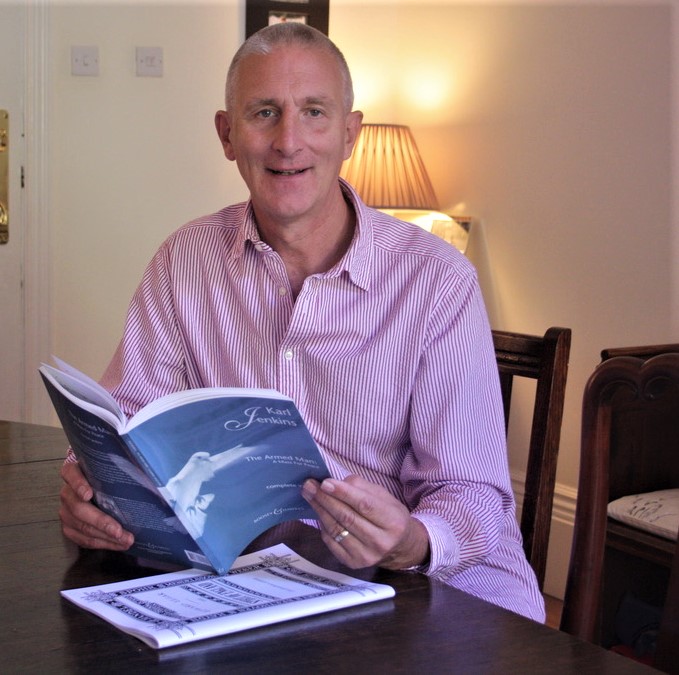
 

Armed Man

The Choir is looking forward to singing The Armed Man by Karl Jenkins in Sheffield Cathedral on Saturday 17 November, with the National Festival Orchestra and soloists Nicola Hooke soprano, Hannah Mason mezzo soprano, Jeremy Dawson tenor and bass Thomas Asher. Jenkins wrote the work as a mass for peace, and many listeners find a live performance to be an extremely moving experience.

The work was a millennial year commission from the Royal Armouries in Leeds, and its text was researched and devised by Guy Wilson, then Master of the Armouries. It was originally intended for another Yorkshire-based composer, Pontefract-born Philip Wilby, who had to decline owing to the demands of other commissions, so the task fell to prominent Welsh composer Karl Jenkins. He tackled the challenge with relish, drawing on the styles and ambiences of music from earlier periods in a very special and original manner.

The verbal text comes from a great diversity of sources: the traditional Latin Mass, the poetry of Rudyard Kipling, the Psalms of David, the popular medieval French song, L’Homme Armé that provides the impetus for the work’s English title, Dryden, Mallory, Alfred, Lord Tennyson and the final book of the bible, the apocalyptic Revelation to St John the Divine; also featured are verbal extracts of Guy Wilson’s own devising and far Eastern poets.

Jenkins draws on the French folk melody of the title, Palestrina’s “parody” mass inspired by the secular song as well as Eastern originals in melody. Perhaps the most appealing number emotionally speaking, the Benedictus, has become a real favourite, as has the beautiful Agnus Dei.

You can read more about the work on Bernard Lee’s excellent website

The Spirit of England, Elgar’s great war-time choral trilogy, uses three texts of Laurence Binyon – The Fourth of August, To Women and For the Fallen. The latter contains the immortal brief stanzas used at so many acts or remembrance all over the English-speaking world:

They shall grow not old, as we that are left grow old: age shall not weary them, nor the years condemn;
At the going down of the sun, and in the morning: we will remember them.

The same text is utilised by organist-composer Mark Blatchly in his setting for upper voices entitled For the Fallen, which ingeniously incorporates the evocative music of The Last Post.

Chair’s 5th anniversary

22 October 2018

It’s five years this October since Chris Walker was elected as Chair of Sheffield Bach Choir – and he isn’t likely to forget the date! ’Our eldest daughter gave birth to our first grandchild Elizabeth a few hours earlier.’ said Chris, ‘I dashed to the AGM straight from the hospital – if I hadn’t been standing for Chair I might have played hooky I think!’

chris walker 1Chris was born in California USA but came to Sheffield to study dentistry in 1978 and decided to stay, working at busy practices in Rotherham, then Wombwell. ‘I fell in love with the rural feel to the city and being able to escape to somewhere wooded or green so easily.’ Now retired, he has an allotment near Ecclesall library, sits on five committees, and helps look after Grade 2* listed St James’ Church, Norton.
He joined the choir almost by chance. ‘I was moaning about work-life balance to my Dad, he happened to know someone in the choir and before I knew it I’d auditioned and was in!’ Chris remembers that first audition, given by Dr Roger Bullivant, who heard Chris sing, then took out an old envelope, drew a bass clef and five lines, scribbled a few notes and barked “Sing that!” The choice of singing was no accident though, as Chris had been a boy chorister at Magdalen College Oxford – as was the choir’s current conductor Dr Simon Lindley. ‘I remember walking across Magdalen Bridge in cap and gown – they don’t do that anymore. I wonder how many tourists still have the faded photographs they snapped as we passed by!’

Some 35 years later Chris still enjoys singing bass in the choir. ‘I’ve loved singing the great choral works including an annual Messiah and our three year rotation of Bach’s St John Passion, St Matthew Passion and the Mass in B minor  – maybe one of the greatest pieces ever written. There’s something special about singing with a professional orchestra in Sheffield cathedral, which has a lovely acoustic; it sends a shiver down the spine and you just can’t beat it! We’ve had a fair few younger people joining us recently but we’re still looking for new members so do give us a go!’

Chris is looking forward to the choir’s next concert, Lest we forget, featuring the Armed Man by Karl Jenkins as well as works by Elgar and Blatchly – but he’s anticipating quite an emotional sing. ‘Remembering the Great War is important, and the Armed Man is a good choice; Jenkins wrote it as a mass for peace.’ explains Chris ‘It’s a really popular atmospheric work and a joy to listen to, especially poignant for me as it was played at Dad’s funeral last year. He and Mum were great supporters of the choir and the Agnus Dei from this work was a particular favourite.’

The choir presents Lest we forget in Sheffield Cathedral on Saturday 17 November at 7.30pm. Tickets from www.sheffieldbachchoir.org.uk; www.wegottickets.com, cathedral shop, or at the door.

Thomas plays Poulenc

Sheffield Telegraph 19 September 2018

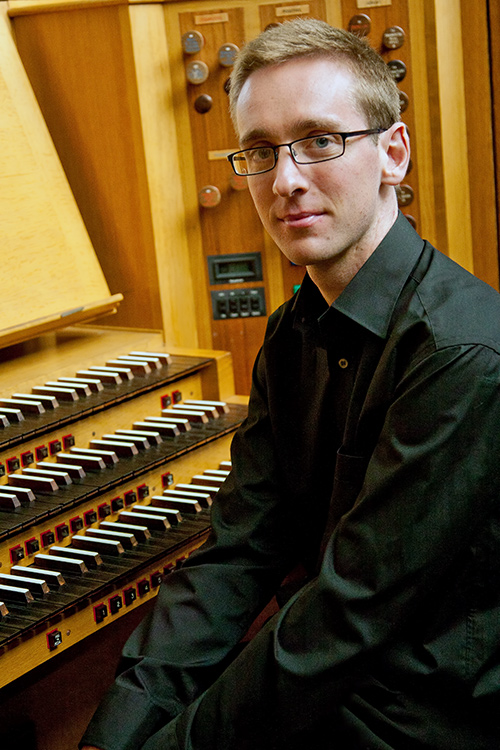
Sheffield Bach Choir is thrilled that Thomas Corns, Director of Music at Sheffield Cathedral, will play at their ‘French Connection’ concert on 6 October. “I’m very much looking forward to playing Poulenc’s Concerto” said Thomas. “It’s the first time I’ve performed with one of Sheffield’s major ensembles as a soloist since my appointment – and it’ll be in the Cathedral where I work!”

thomas corns 1Prize-winning graduate of the Royal Academy of Music, Thomas held organ scholarships at Cambridge and St Paul’s Cathedral and has performed on TV and radio. Thomas feels privileged to be nurturing the centuries-old tradition of choral singing in this wonderful venue. “I enjoy working with the talented boys and girls who come from across the city to be choristers, and with the professional musicians and students of the choir.”

The choristers will join the Bach Choir to sing Duruflé’s Requiem, Faure’s well-known Cantique and Poulenc’s exquisite Salve Regina, with mezzo soprano Joanna Gamble and baritone Thomas Asher. Singing with the altos will be Thomas’ wife Claire, who joined the choir shortly after their arrival in 2017.

As a child Thomas was inspired by the organ playing at Wells cathedral where he was a chorister. “Good organs often have a tremendous expressive range but they are also impressive instruments” he explained. “Playing a cathedral organ to thousands of people on an important occasion can feel like a big responsibility – but it’s also great fun!”

Staying with the organ theme, two days later the choir’s music director Simon Lindley presents a free recital at Nether Green Methodist Church on the magnificent Father Willis organ, which was almost certainly played at his grandparents’ wedding in 1916.  “Henry ‘Father’ Willis built organs in St Paul’s cathedral, the Royal Albert Hall and Windsor Castle, as well as the somewhat smaller but no less fine example now at Nether Green” said Simon. “My grandmother Elsie May lived on Gladstone Road, Ranmoor, but moved to Leeds after her marriage to Rev Francis Joshua Lindley”. Music and ministry run in the family; Simon’s sister Ruth was a singing tutor who sang in the London Oratory Choir, his late father was a minister and his cousin Lisa lives in Sheffield and sings with Sheffield Bach Choir.

The recital is organised by the choir with Sheffield & District Organists’ and Choirmasters’ Association, of which Simon is President-Elect, in commemoration of the Armistice Centenary, which the choir will also mark by presenting Karl Jenkins’ Armed Man at the cathedral on 17 November. “This recital includes works by Elgar, Butterworth and Vaughan Williams” explained Chris Walker, Chair of Sheffield Bach Choir. “It will be a wonderful evening rounded off by a free buffet. We hope readers will come to hear Simon play the organ that has such a special place in his family history – especially since it’s his 70th birthday two days later!”

The recital is free, with a retiring collection for choir funds; details from www.sheffieldbachchoir.org.uk.

Tickets for the cathedral concert from www.sheffieldbachchoir.org.uk, www.wegottickets.com, Sheffield Cathedral shop, or at the door.

Rising stars move mountains to sing Bach in hometown Sheffield

Sheffield Telegraph 5 April 2018

Booking musicians with growing national reputations is difficult; getting them a second time following a postponement is well-nigh impossible – but not when they are committed to singing in their hometown!

Rising stars Anna Harvey and Ella Taylor from Sheffield have moved mountains to sing Bach’s St Matthew Passion at the cathedral on Saturday 14 April, following a snow-enforced postponement of the original concert.

Both live in London but despite busy schedules are adamant about meeting their commitment to sing Bach’s masterpiece. Sheffield Bach Choir faced a herculean task in bringing together soloists, choristers and orchestra for the re-scheduled concert. ‘The Passion obviously has to be performed within the Easter period’ said Music Director Dr. Simon Lindley, ‘ It is a delight, as well as something of a relief, that Anna and Ella, along with tenor Stephen Liley and bass Thomas Hunt in the roles of Evangelist and Christ, all happen to be free for the rearranged date. We are very pleased to have secured Quentin Brown to make up our team of soloists’.

Hailed as ‘simply wonderful’ by the New York Times, mezzo-Soprano Anna Harvey was a pupil at Broomhill, Lydgate and Tapton schools, and graduated in Music from Cambridge University. The holder of a number of prestigious awards, Anna recently sang in Mozart’s Requiem on a national tour that included Sheffield City Hall, and is thrilled to be back: ‘Having grown up in Sheffield, I am very excited to be returning to my home city to sing this wonderful and monumental work by my favourite composer, Bach’.  Anna, who sings with the Welsh National Opera and enjoys a busy concert schedule, counts performing at the 2016 Last Night of the Proms at the Royal Albert Hall as a particular highlight.

Ella, whose earliest musical memory is being ‘part of a string group called ‘Fiddle Fingers, where I first picked up a violin!’, cut her teeth as a chorister at the cathedral, winning BBC Chorister of the Year in 2010. She went on to graduate in Music from the University of Sheffield and is currently studying for a Masters in Performance at the Royal Academy of Music. ‘My passion lies in performing new/contemporary works’ says Ella, ‘I have been lucky to premiere several pieces by up-and-coming composers, as well as works by Schönberg and George Benjamin, among others’.

The Bach choir will be joined by members of St Peter’s Singers from Leeds in the celebrated choruses for double choir, while the acclaimed young Choristers of St John’s Ranmoor will provide the thrilling chorus of upper voices required by Bach in the first half. The audience is encouraged to sing the chorale hymns as would have happened in Bach’s day.

However, you’ll need to set out early – it starts at 6.30pm and there is always competition for prime spots in the cathedral’s grand acoustic. Tickets for the original concert are valid, those without tickets can get them from http://www.sheffieldbachchoir.org.uk/

Link to the article in the Sheffield Telegraph